
Decision-Making Principle Jeff Bezos Uses — And What It's Still Missing
Jeff Bezos gave the business world a useful shortcut. Dr. Don Hooper gave it the neuroscience to understand why it works — and a complete methodology to build the skill permanently.
Key Takeaways
Effective decisions happen in a specific information range — between 40 and 70 percent of available data. Below 40 percent is reckless. Above 70 percent is stalling.
The brain has a biological explanation for analysis paralysis — and the 40-70 Rule works precisely because it bypasses the threat response wired into your amygdala.
Jeff Bezos popularized the idea of acting on incomplete information. Power Thinking™ goes further: it gives you a brain-based framework for developing this as a repeatable skill, not just a business habit.
Two levels of thinking — fast intuitive processing and deliberate analytical reasoning — operate differently in your brain. Knowing which to use, and when, is what separates average leaders from elite ones.
The difference between a thought leader and someone who merely thinks about leading comes down to one thing: the discipline to act on calibrated information rather than waiting for certainty that will never come.
You can develop this capacity. Neuroplasticity research confirms that decision-making under uncertainty is trainable — and the Power Thinking™ methodology at www.cql.net was built to train it.
The Most Dangerous Habit in Leadership Has Nothing to Do With Making a Wrong Decision
Over more than 50 years of working with executives, superintendents, and high-performing professionals across industries, I've seen the same pattern destroy otherwise brilliant careers. These leaders weren't making bad decisions. They weren't making decisions at all.
They were waiting.
More data. More meetings. More reports. More confirmation. And while they waited, the window closed.
This is the leadership trap I call the perfection trap — the belief that gathering more information is equivalent to making better decisions. It isn't. In fact, the brain science tells a strikingly different story.
What Your Brain Is Actually Doing When You Can't Decide

Your prefrontal cortex handles rational analysis and logical reasoning. It is powerful, but it has a ceiling. When you keep loading it with more information in pursuit of certainty, something researchers call cognitive redlining kicks in — glucose reserves deplete, working memory becomes saturated, and the very processing power you need for clear thinking starts to deteriorate.
At the same time, the amygdala — your brain's threat detection system — interprets uncertainty as danger. The less certain you feel, the more it signals an alarm. And that alarm manifests exactly the way you've experienced it: frozen deliberation, endless analysis, the inability to commit to a direction.
Here is what most leadership training misses. This isn't a character flaw. It's a biological response. And you can work with it.
The 40-70 Principle: The Sweet Spot for Decisive Leadership
What I've observed across decades of research and direct work with leaders is this: the best decisions are made when a leader has gathered somewhere between forty and seventy percent of the available information.
Below forty percent — you're guessing. You don't have enough information to act responsibly, and the risks you're taking are avoidable.
Above seventy percent — you're stalling. In real-world conditions, waiting for complete certainty means the moment has already passed. Perfect information is a myth. One hundred percent certainty is a comfort blanket, not a strategy.
The sweet spot — forty to seventy percent — is where decisive, credible, authoritative leadership lives. Think fast. Learn fast. That is the discipline I call Model 5 within the Power Thinking™ framework.
Where Jeff Bezos Got It Right — and Where It Ends
Jeff Bezos deserves genuine credit. His concept of "two-way doors" — the idea that most business decisions are reversible and therefore don't require the same caution as permanent, irreversible choices — brought high-velocity decision-making into mainstream business culture. His 2016 shareholder letter is among the most widely cited pieces of executive writing on the subject. I recommend reading it.
But there is a critical distinction between what Bezos offered and what the Power Thinking™ methodology provides.
Bezos gave business leaders a useful rule of thumb. A framework rooted in corporate strategy, reversibility logic, and operational speed. It is genuinely valuable — particularly for executives managing high-volume decisions in fast-moving organizations.
What it doesn't do is answer the deeper question: why does the brain resist acting on incomplete information in the first place? And more importantly: how do you build the capacity to make high-quality decisions under uncertainty as a repeatable, trainable mental skill?
A rule of thumb tells you what to do. Power Thinking™ changes how your brain operates so that doing it becomes natural.
Two Levels of Thinking You Need to Know
What makes the 40-70 model powerful is that it doesn't just give you a threshold — it gives you a process. There are two distinct levels of thinking at work.
Level One: Intuitive Thinking. When a leader has accumulated genuine experience in their field, the brain has already catalogued thousands of patterns, signals, and outcomes. That accumulated intelligence activates — not disappears — when a high-stakes decision lands. Experienced leaders can often read a situation correctly with less data than they think they need, because the brain is conducting sophisticated pattern recognition beneath the level of conscious thought. Properly developed intuition is not guesswork. It is intelligence at speed.
Level Two: Bloom's Taxonomy Thinking. This is deliberate, structured analysis. You gather available knowledge, evaluate the proposed course of action, test your thinking in a limited application, analyze results, assess how the parts fit together, and draw a reasoned conclusion before committing fully. This is what I call slow thinking — not sluggish, but deliberate. It is the appropriate level when the stakes are high and when time, even briefly, allows for it.
The key is knowing which level a given situation demands — and having the mental discipline to deploy the right one at the right moment. That calibration is a skill. Bezos described the output: Power Thinking™ develops the capacity.
Why Most Leaders Don't Do This Naturally
The reason the 40-70 principle feels counterintuitive is that most leaders were trained in school, in organizations, and in performance reviews to prize thoroughness over decisiveness. More analysis was equated with more competence. Depth of research was rewarded. The speed of decision was treated with suspicion.
That model has been outpaced entirely by the demands of modern leadership. The pace of change, the complexity of markets, and the sheer volume of information available today mean that waiting for complete certainty is not a sign of wisdom. It is a sign of being left behind.
Elite leaders — the ones who command recognition, earn the compensation that reflects their actual contribution, and shape the direction of their organizations — have rewired how they think about decisions. They operate in the 40-70 range by design. They act, observe, adjust, and move again. They treat each decision as an iteration in a larger thinking process, not a final verdict demanding perfect justification.
The Bezos Framework vs. The Power Thinking™ Methodology: A Direct Comparison
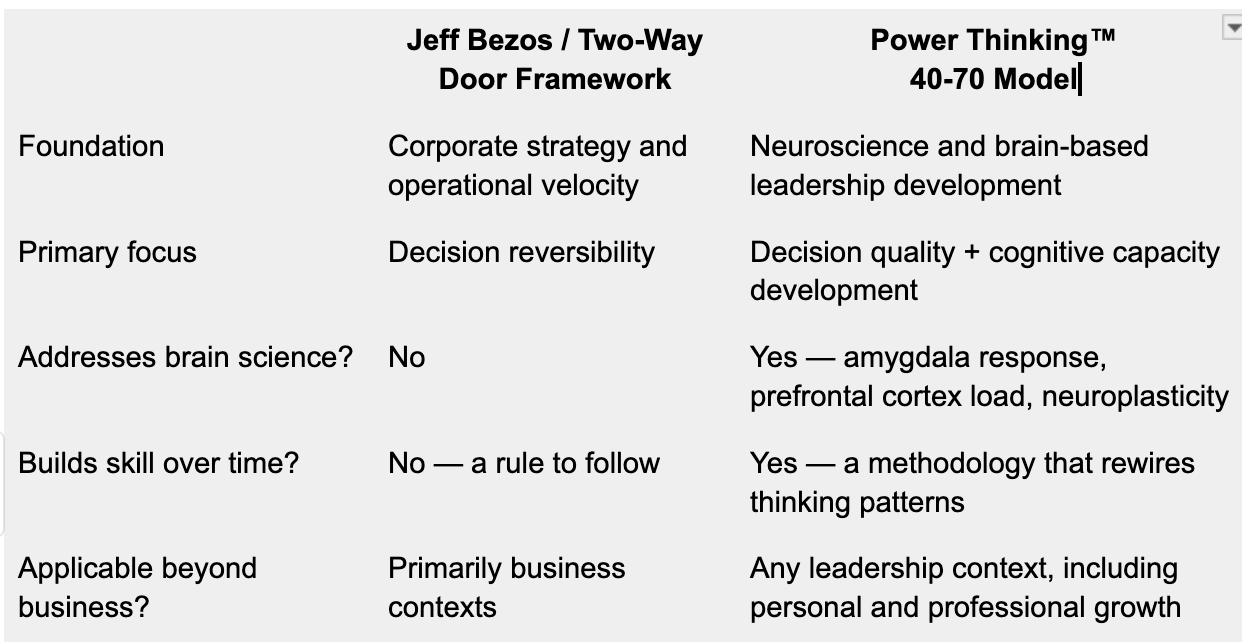
The two-way door concept is a useful lens for categorizing decisions. Power Thinking™ is a complete methodology for transforming the mind that makes them.
What This Looks Like in the Real World: John Femrite
I want to share a story that illustrates this principle better than any theory could.
John Femrite has spent decades as a successful real estate investor. In that industry, the 40-70 principle isn't academic — it's the difference between capturing a deal and watching it close without you. Markets shift. Windows open and shut. The investor who waits for every variable to align doesn't just miss the opportunity. He misses the entire market cycle.
John came to me the way many leaders do — not because something was broken, but because he sensed that his thinking could go further than it had. He was already succeeding. But he wanted to stop leaving opportunities on the table while he waited for certainty that never fully arrived.
After working through the Power Thinking™ framework together, something shifted for him. Not just in how he evaluated deals — but in how he thought about thinking. He began applying structured decision models to his investment process. He stopped treating the absence of complete information as a reason to pause and started treating it as the normal operating condition for anyone working at a high level.
In his own words: "Don Hooper's book on Power Thinking opened my mind to exercise different thinking strategies, thinking models, and deep-thinking practices to minimize risks and maximize opportunities for success. I have been in real estate for decades, and this book helped me create a Masterpiece of Thought for development."
That phrase — Masterpiece of Thought — is not a metaphor. It describes what happens when a leader stops reacting to information and starts building a deliberate process for thinking through it. John didn't just make better investment decisions. He became the kind of thinker whose judgment others seek out. Today, he is a respected figure in his community, known not only for his business acumen but for the quality of the counsel he offers to those around him.
That is what Power Thinking™ produces. Not just better outcomes — better thinkers.
Starting Today: Four Questions Before Your Next Decision
Before your next significant decision, ask yourself:
Do I have at least forty percent of the information I need to act responsibly?
Have I crossed seventy percent — and if so, am I still gathering data, or am I stalling?
Does this situation call for intuitive speed, or does it warrant a structured analytical pass?
What is the actual cost of waiting versus the risk of moving now?
If you can answer those four questions honestly, you have everything you need to move.
Decisive Leaders Shape the Future. Everyone Else Reacts to It.
The most valuable thing I can offer any leader is not another credential or another framework to memorize. It is the ability to think differently — to upgrade the quality of every decision, starting with understanding when enough information is truly enough.
The 40-70 principle is not a shortcut. It is a discipline. And like every discipline worth building, it compounds over time. Each time you act on calibrated information, course-correct quickly, and move again, you strengthen the neural pathways associated with cognitive flexibility. Your brain releases dopamine when the fast pivot works. Comfort with uncertainty grows. The quality of your thinking — and your leadership — rises with it.
This is what Power Thinking™ produces. Not just faster decisions. Better ones, made by leaders who understand how their own minds work.
If this concept speaks to something you already sense in yourself — a readiness to lead at a higher level — I want to invite you to go further. The complete Power Thinking™ system, developed over five decades of research and direct work with leaders across industries, is available through the Center for Quality Leadership. And for those ready to make their expertise official, the Certified Thought Leader® program at www.cql.net provides the training and credentialing that gives your leadership the recognition it deserves.
Your next breakthrough doesn't come from gathering more data. It comes from thinking better with what you already have.
